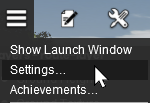
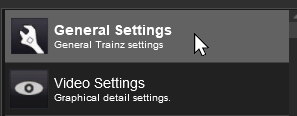
|
|
| Line 147: |
Line 147: |
| <tr valign="top"> | | <tr valign="top"> |
| <td>[[image:DotPoint5.JPG|link=]]</td> | | <td>[[image:DotPoint5.JPG|link=]]</td> |
| <td>Open the <span style="font-weight: 700; font-size: 15px;">Content</span> and select the <span style="font-weight: 700; font-size: 15px;">Enable</span> option.</td> | | <td>Open the <span style="font-weight: 700; font-size: 15px;">Content</span> menu and select the <span style="font-weight: 700; font-size: 15px;">Enable</span> option.</td> |
| </tr> | | </tr> |
| </table> | | </table> |
Revision as of 23:51, 17 October 2026
|
|
| Key Points:- |
 |
Missing Dependencies (and Unknown Assets and assets with Unknown Locations) are components of an installed asset, such as a route or a locomotive, that were not located during the install process |
|
There are several possible causes for this condition for an asset, from not being available anywhere on the Internet to being deleted or disabled in Content Manager |
|
Some Missing Dependencies can be deleted or replaced without affecting the operation of a route or a session |
|
| Missing Dependencies can occur when an asset:- |
 |
has been installed from a .cdp file (e.g. from a 3rd party web site) or from a content folder (e.g. on your HD) without also installing other assets it requires.
If an asset with Missing Dependencies has been installed using the Import Content Files... or Import Content Folder... options in the File menu of Content Manager, then the missing assets may be on the DLS. When these two import methods are used Content Manager does not check the DLS for any missing dependencies. |
| |
| Steps: If you have used either of these methods to install an asset, then:- |
 |
Select (highlight) the newly installed assets that have been marked as having Missing Dependencies |
 |
Right Click on any one of the highlighted assets and select the option List Dependencies |
 |
IF any of the listed assets in the new Content Manager window are labelled as Available for Download then Right Click on them and select the option Download |
|
|
 |
has been Disabled or Deleted in Content Manager. |
| |
If an asset has been Disabled then it is still installed but it is blocked from being used. Removing the block will make it available for use. |
| |
| Steps: To Identify and Restore any Disabled Assets in Content Manager:- |
|
In Content Manager select (highlight) the assets that have been marked as having Missing Dependencies |
|
Right Click on any one of the highlighted assets and select the option List Dependencies |
|
Left Click on the Status column heading to sort the rows into category order (i.e. all Built-in assets together, all Installed for DLS assets together, all Packaged assets together, etc). |
 |
Scroll down through the list. Any assets that have been Disabled will appear at the end of each category. Select (highlight) the Disabled assets. |
 |
Open the Content menu and select the Enable option. |
|
|
 |
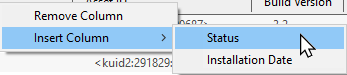
If the Status column is not present in the Content Manager display, then:-
| Steps: To Add the Status Column:- |
|
Right Click on the column heading where you want it to be inserted |
|
select Insert Column and then Status |
 |
|
|
|
| |
If an asset has been Deleted then it is no longer installed. It can be reinstalled if it is on the DLS. |
| |
Steps: To Identify and Restore any Deleted Assets in Content Manager:-
 |
If the deleted asset is not on the DLS then this method will not locate and download it |
|
|
In Content Manager select (highlight) the assets that have been marked as having Missing Dependencies |
|
Right Click on any one of the highlighted assets and select the option List Dependencies |
|
Left Click on the Status column heading to sort the rows into category order (i.e. all the Available for Download assets together).
|
If the Status column is not present in Content Manager then refer to the Tips in the Steps above |
|
|
Scroll down through the list. Select (highlight) any assets that are labled Available for Download. |
|
Right Click on any one of the selected assets and select the option Download |
|
|
|
 |
has been downloaded from the DLS but contains dependency assets that are not on the DLS or built-in.
Downloaded assets can sometimes contain dependencies that are not on the DLS or Built-in (ones that came installed with Trainz). This can lead to frustrations especially if the creator of the downloaded asset has not provided any information on where these missing assets can be found. Even when the location, such as a 3rd party web site, has been identified that site may no longer exist. |
| |
If the missing assets are not on the DLS then fixing this may not be easy. Possible solutions are:- |
| |
|
|
|
|
Delete the Asset Containing the Missing Dependency: If the missing dependency is crucial to the asset, e.g. bogies on a locomotive, interactive industries in a route or there are simply too many missing dependencies, then deleting the asset (e.g. the locomotive or the route) may be the best and only practical option. |
|
Delete and Ignore the Missing Dependency: If the missing dependency is part of a route but is not crucial to the route, e.g. one type of tree in a forest, then it could be deleted from the route and ignored. The option below is also a possibility. |
|
Delete and Replace the Missing Dependency: If the missing dependency is part of a route or session and has a role in that route or session, e.g. a track object or a rolling stock asset, then it might be possible to delete it and replace it with a similar asset. |
| Where the missing dependency is part of a route or a session, then it is important to discover where that dependency is located and how it is used before making a decision on which of these three options to use. |
|
|
Missing splines and tracks in a layout will be shown as white dotted lines |
|
Missing textures will be, conditionally, shown as a bright blue colour |
|
Missing scenery objects, including rolling stock track objects (e.g. signals, switches) will NOT be visible at all |
Missing Splines (including Track)
| In the following examples... |
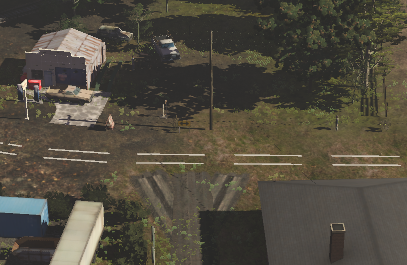 |
The missing spline asset is most likely a road. If deleted it will leave a "space" in the route but it will not affect the operation of sessions that use this route, just their appearence.
It could be replaced by any suitable road spline. |
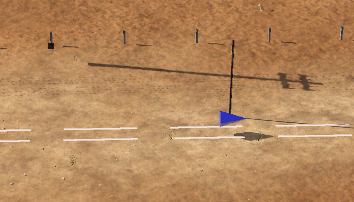 |
The missing spline asset is rail track - the presence of the track objects is a major clue. If deleted it WILL affect the operation of sessions that use this route.
It could be replaced by any suitable rail track spline. |
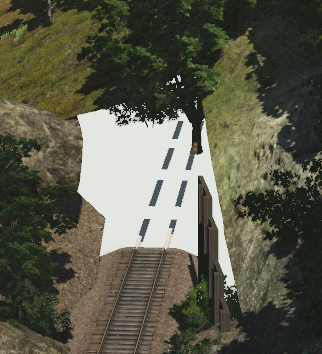 |
The missing spline asset is a tunnel with track. If deleted it will leave a gap in the route and it WILL affect the operation of sessions that use this route.
It could be replaced by another suitable tunnel spline. |
Missing Textures
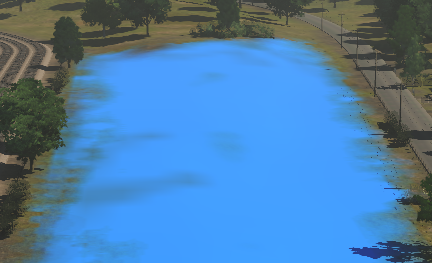 |
The false blue colour indicates that the missing asset is a ground texture. If deleted it will not affect the operation of the route, just its appearence.
It could be replaced by any suitable ground texture or you could leave any pre-existing texture in place.
|
If you zoom out the blue colour will vanish to reveal any ground texture that was originally painted at that location before the missing texture was added.
Zooming back in again will not return the blue colour to the scene. |
|
|
Missing Scenery Objects (incl Rolling Stock and Track Objects)
| Locating these objects in a layout can give you useful clues as to what the missing assets are (e.g. trees/bushes, cars, buildings, signals, wagons, etc).
|
| Steps: To Locate Missing Scenery Objects in a Layout |
|
|
|
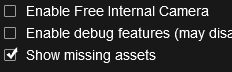
| With the Show missing assets check box set on, each scenery object that is missing from the route or session will be shown as an Orange Wire Frame Box in Surveyor. They will still be invisible in Driver. |
| In the following examples... |
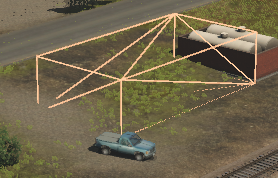 |
From its size and shape, the missing asset is most probably a building. If deleted it will leave a "space" in the route but it will not affect the operation of sessions that use this route, just their appearence.
It could be replaced by any suitable similar sized building asset. |
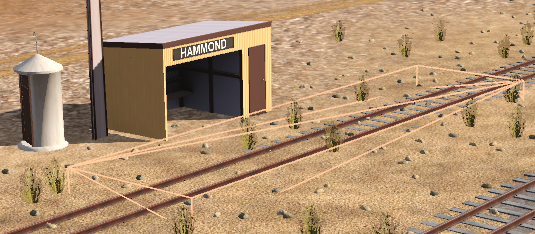 |
The missing asset is almost certainly an Industry Active Platform, possibly an invisible platform. The presence of a visible station building indicates that the missing asset is just the platform. If deleted it WILL affect the operation of sessions that use this route.
It could be replaced by a similar sized Industry Active platform asset but its properties and the session rules would have to be edited. |
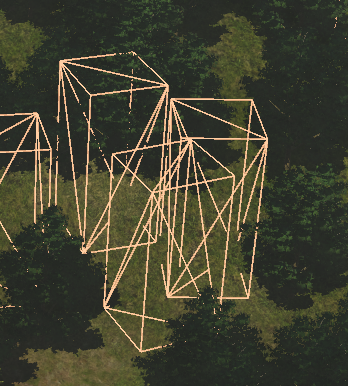 |
From its size, shape and location, the missing asset (or assets - there may be several different missing assets) is most likely a tree. If deleted it will leave gaps in the forest but it will not affect the operation of sessions that use this route, just their appearence.
It could be replaced by any suitable similar sized tree asset. |
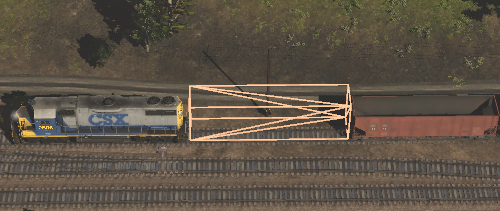 |
The missing asset is clearly rolling stock. If deleted it WILL affect the operation of the session.
It could be replaced by an alternative rolling stock asset but session rules and driver commands (coupling and decoupling) may have to be edited. |
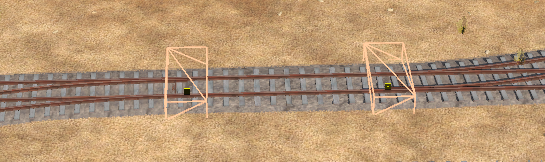 |
Because of its position on the track the missing asset is clearly a track object and almost certainly a track switch. If deleted it COULD affect the operation of the session depending on the type of track object (switch track objects WILL have an effect while caution and whistle signs will probably not).
It could be replaced by an alternative track object asset but session rules (e.g. "Set Junction Rule") and driver commands (e.g. "Drive to Trackmark") may have to be edited. |
Currently Under Construction
Trainz Wiki
 |
More Tutorials and Guides to Using Trainz
|
|
 |
Related Links
|
|
This page was created by Trainz user pware in October 2026 and was last updated as shown below.